
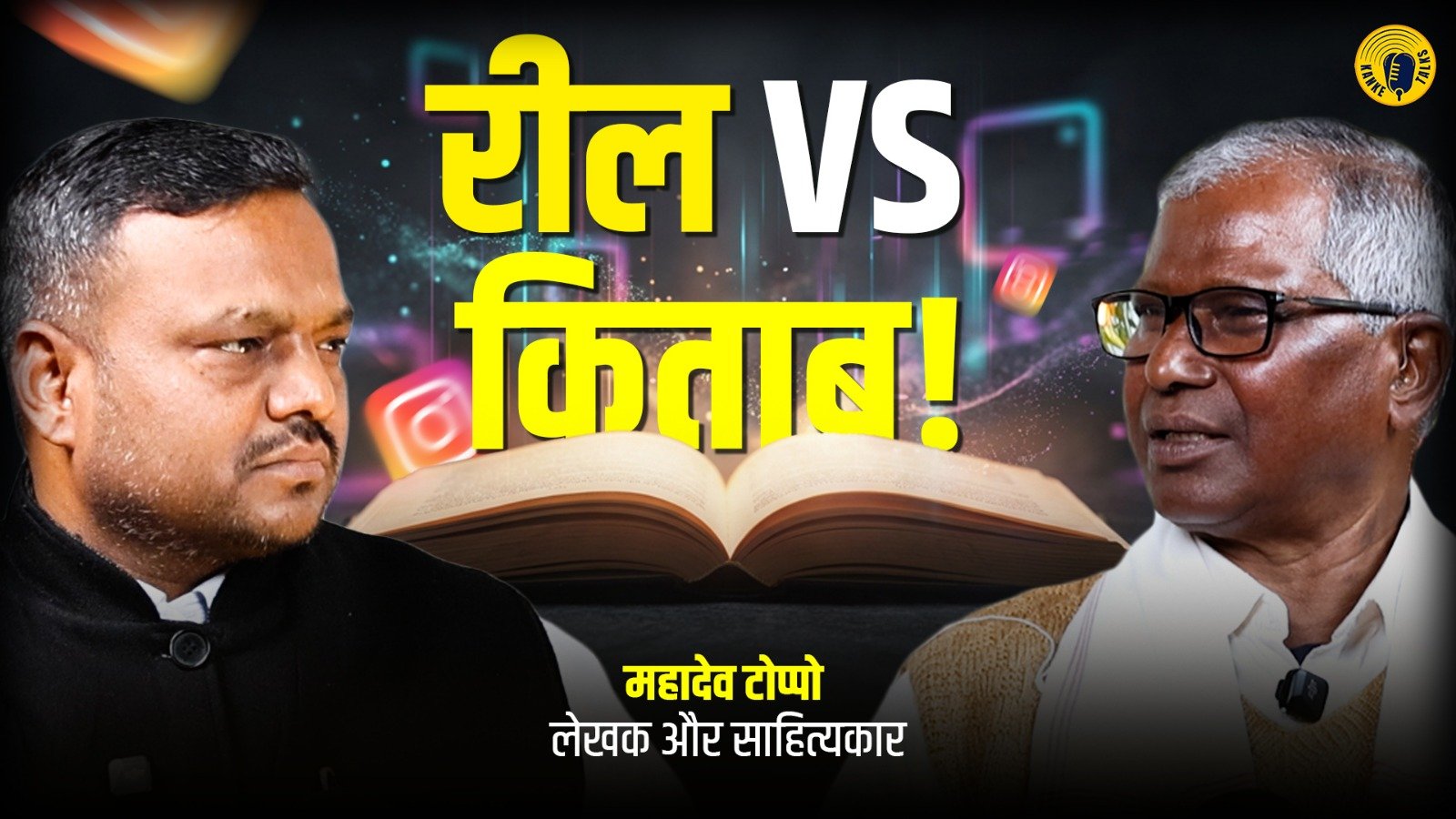
In an era dominated by Instagram reels, AI summaries, and fast content, one serious question remains: Is literature still alive?
This question was deeply explored in a powerful episode of KankeTalks featuring noted Adivasi writer and thinker Mahadeo Toppo. The discussion moved beyond books and entered the realms of identity, dignity, forests, and the future of modern India.
This article presents a natural, human-centered blog version of that conversation — written for clarity, depth, and meaningful engagement.
If Literature Is a Mirror, Where Are the Adivasis?
We often hear that literature reflects society. But Mahadeo Toppo raises a critical point:
If literature truly reflects society, why was Adivasi life missing from mainstream narratives for so long?
During the 1980s, the Jharkhand movement was often misunderstood and labeled negatively. At the same time, Adivasi voices were rarely represented authentically in national literature. This was not just a literary gap — it was a social gap.
Every community has two images:
- One created by outsiders.
- One created by the community itself.
When these two images don’t match, misunderstanding grows. Literature becomes essential at that point. It builds dialogue.
From Oral Tradition to Written Resistance
Adivasi culture has always been rich in storytelling — through songs, folklore, rituals, and collective memory. The absence of written texts never meant absence of literature. It simply meant literature lived in voices rather than printed pages.
A turning point came when Mahasweta Devi wrote about Birsa Munda in Aranyer Adhikar. For many readers across India, this was the first serious introduction to Adivasi resistance and history.
Similarly, Laxman Gaikwad’s Uchalya exposed the harsh realities faced by communities once labeled as “criminal tribes.”
These works did not just tell stories. They forced society to look again — and look honestly.
Forests: Backward or Foundational?
One of the most powerful ideas shared in the podcast was about forests.
For decades, forests have been associated with backwardness in mainstream narratives. But is that accurate?
Forests are the origin of rivers, clean air, medicinal plants, and biodiversity. Indigenous communities see nature not as a resource to exploit, but as a partner in coexistence.
Before cutting a tree, it is greeted. Animals are honored during festivals like Sohrai. This is not superstition — it is philosophy.
In today’s climate crisis, this worldview feels less primitive and more necessary.
Why Read Premchand in the Age of Reels?
A direct question was asked:
If a 30-second reel can make someone emotional, why read Premchand?
The answer lies in depth.
Reels create quick emotion. Literature builds lasting reflection.
When you read a novel, you imagine the characters. You enter their struggles. You wrestle with moral conflict. Writers like Rabindranath Tagore and other classical authors explored human suffering, inequality, love, and dignity in ways that still feel relevant.
Visual media shows you a scene.
Literature makes you build it inside your mind.
That mental engagement strengthens empathy and imagination.
Is Literature Only for the Elite?
In many parts of India, reading novels is seen as a luxury. But regions with strong reading cultures — such as Bengal and Kerala — show that literature grows where education and middle-class participation grow.
In Adivasi communities, written literary culture developed later due to limited access to education and publishing. However, scholars like Ramdayal Munda helped academically document Adivasi spirituality and philosophy.
Poets such as Nirmala Putul and Anuj Lugun brought indigenous voices into mainstream Hindi literature.
The growth of Adivasi literature is not elitism — it is assertion.
Spiritual, Not Just Religious
A powerful statement from Mahadeo Toppo stands out:
“Adivasis are not religious in the rigid sense — they are spiritual.”
The difference matters. Indigenous belief systems are rooted in nature, community, and coexistence — not in institutional hierarchy.
Historically, Adivasi identities have often been misunderstood or absorbed into broader religious categories. Leaders like Jaipal Singh Munda articulated tribal identity politically. Literature gave it emotional depth.
Literature as Healing
Perhaps the most honest moment in the conversation came when Toppo spoke about dignity.
He shared that being questioned simply for being an Adivasi in positions of authority left deep emotional scars. Writing became his response.
He said that if he had not picked up a pen, he might have picked up something else.
This is where literature becomes more than art.
It becomes healing.
It becomes resistance without violence.
It allows pain to transform into perspective.
Technology vs Literature
Yes, the digital age has changed reading habits. AI summaries and quick searches are convenient. But convenience cannot replace depth.
Literature requires time.
Time builds understanding.
Understanding builds empathy.
Platforms like KankeTalks show that meaningful conversations can survive even in digital formats — if intention remains sincere.
Final Reflection: Is Literature Still Alive?
Yes. Literature is alive wherever there are questions.
As long as humans struggle with identity, injustice, love, memory, and survival — literature will exist.
Adivasi literature especially reminds modern India of something essential:
Progress without empathy is incomplete.
Development without nature is dangerous.
Identity without dialogue creates division.
Literature keeps that dialogue alive.
And that is why it is not only alive — it is necessary.
Related Blog
- Sarhul: Jharkhand’s Living Science of Nature, Culture & ExistenceSarhul: Jharkhand’s Living Science of Nature, Culture & Existence


